

- Sku:
- Vendor: Military Aviation Art Prints
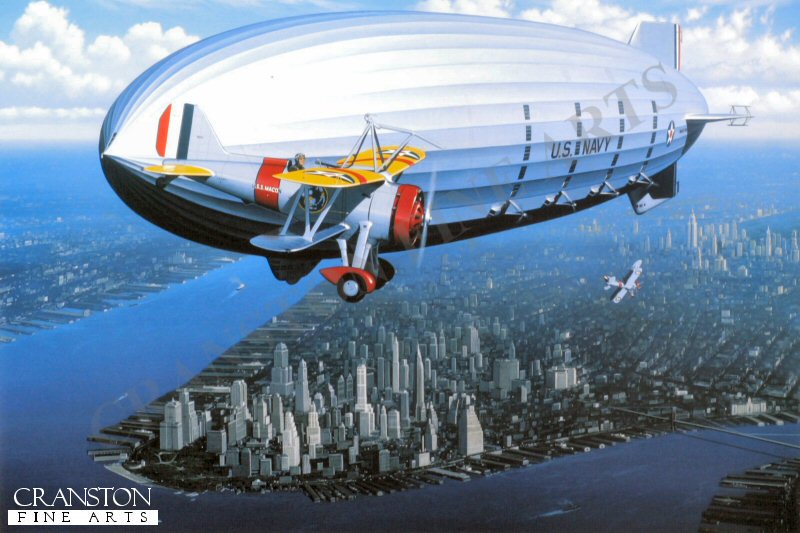
Sparrowhawks of the Macon by Stan Stokes.
Type: Print
In 1924 the US Navy took delivery of the Los Angeles, which was built by the Zeppelin Company in Germany. A partnership was formed between the Goodyear Company and the Zeppelin Company for developing rigid airships in the United States. Rear Admiral William A. Moffett was unquestioned booster of the rigid airship program in the United States during the 1920s and 1930s. As chief of the Bureau of Aeronautics Moffet had considerable influence. In 1926 he was successful at getting Congress to allocate funds for the construction of two 758-foot long rigid airships (the USS Akron and the USS Macon) with a capacity of 6.5 million cubic feet of helium, more than twice the size of the Graf Zepplin which would circle the globe in 1929. The Goodyear company commenced construction of a huge hangar at Akron which would be used for construction of the first of the two massive airships. Utilizing three keels and thirty-six longitudinal girders, the Akron had a sturdy airframe. One of the most novel features of these two new airships would be their ability to launch and recover Curtis F9C-2 Sparrowhawks, making them the first flying aircraft carriers. The Akron was completed in September of 1931, but it would be nearly a year later before the Sparrowhawks were deployed. The Akron logged about 1,700 hours of flying time, but on the night of April 1, 1933 the Akron crashed in the icy Atlantic off the New Jersey shore with few survivors. Admiral Moffett was one of the fatalities. It was the worst aviation disaster in history - at that time. Construction of the Macon was completed only weeks after the loss of its sister ship. Some improvements had been made to her design. She was lighter and faster than the Akron, and could carry up to five Sparrowhawks vs. only three for the Akron. Following testing of the new airship in the New York- New Jersey area, the Macon was ordered to newly named Moffet field in Sunnyvale, California. On July 18, 1934 the Macon utilized its Sparrowhawks to intercept a pair of US Navy ships at considerable distance off the Pacific Coast. The cruiser USS Houston was carrying Franklin D. Roosevelt on a trip from Panama to Hawaii. Startled to encounter aircraft at such a considerable distance from land, they would be even more shocked when the Sparrowhawks would deliver newspapers and mail for the President. In the late summer and fall of 1934 the Macon was sent east for fleet training exercises in the Atlantic. Utilizing a simple radio homing beacon for the first time the Macon proved beyond a doubt that the concept of air launched scouting planes was feasible. However, in February of 1935 the USS Macon met the same fate as its sister ship. While cruising up the California coast near Point Sur, the great airship encountered turbulence and began to break-up. Fortunately, only two of the eighty-three man crew were lost.
Supplied with signed and numbered certificate of authenticity.
Signed limited edition of 4750 prints.
Print size 16 inches x 11.5 inches (41cm x 30cm)
Have a question?
Sparrowhawks of the Macon by Stan Stokes.